Most small and mid-sized shop owners already sell on WhatsApp. Photos of new stock, a price typed underneath, a customer asking bhaji, ye kitne ka hai, an address shared, a UPI screenshot as proof of payment. It works. It has worked for years.
So when someone arrives selling "WhatsApp commerce", the honest question isn't whether WhatsApp can sell things. It's whether the official tooling does anything your existing method doesn't already do — and what that costs.
Here's what we've found building these systems.
The catalogue is a product list, not a shop
WhatsApp's catalogue lets you attach a structured product list to your business number. Customers browse it inside the chat instead of scrolling back through months of photos.
The limits are firmer than most people expect:
500 products, maximum. Per catalogue.
One catalogue per WhatsApp Business Account. Not one per number, one per account. If you run three brands under one business account, they share a single catalogue. Splitting them means splitting your accounts, which means splitting your numbers, your team access, and your billing.
Ten images per product.
For a tea shop, a boutique, an auto parts dealer, a bakery — 500 is more room than you'll use. For a distributor with a thousand SKUs, the catalogue isn't your product database. It's a curated shortlist of what you actually want to sell in chat, and treating it as anything more will end badly.
The fork that decides everything: App or Platform
This is the decision that determines whether any of the rest is worth doing, and it's the one most people skip past.
The WhatsApp Business App is the free one you download. It supports a catalogue, but every product is maintained by hand, one at a time, on a phone. Change your prices and you change them individually. It also does not support multi-product messages, which we'll come to.
The WhatsApp Business Platform — what most people mean by "the API" — supports the whole feature set, but you don't access it directly. You go through a Business Service Provider, and setup runs about three to five working days.
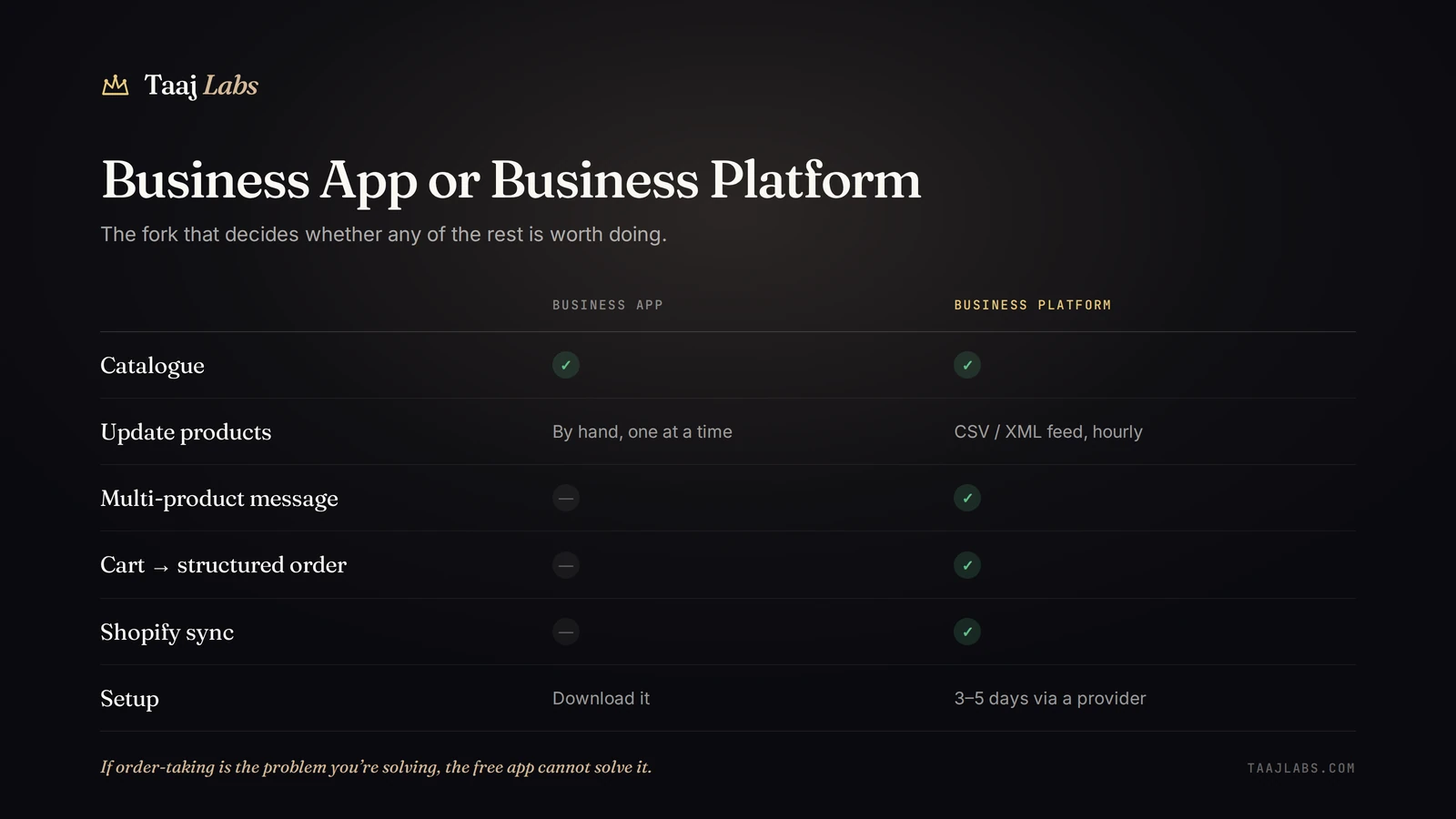
The practical difference shows up in one feature. A single product message sends one item into a chat: fine for "here's the one you asked about." A multi-product message sends up to thirty items with a cart, and the customer selects what they want and sends back a structured order — not a paragraph you have to decode and retype.
Multi-product messages are Platform-only. If order-taking is the problem you're solving, the free app cannot solve it, and no amount of clever configuration changes that.
One more thing worth knowing before you commit: catalogue sync is not real-time on either path. The Platform can pull from a CSV or XML feed on an hourly cycle, or sync from Shopify through Meta's Commerce Manager. Hourly. If your prices move faster than that — and in a lot of trades they do — the catalogue will sometimes be wrong, and you need a plan for that rather than a surprise.
How the pricing really works
WhatsApp Business billing is per message, and the category of message matters far more than the volume. There are four, and the gaps between them are enormous.
Marketing — promotions, offers, anything you send to start a conversation. By a wide margin the most expensive category: roughly seven times what a utility message costs.
Utility — order confirmations, delivery updates, payment reminders. Cheap. And free when sent inside the service window.
Authentication — OTPs. Priced similarly to utility.
Service — free. No monthly cap.
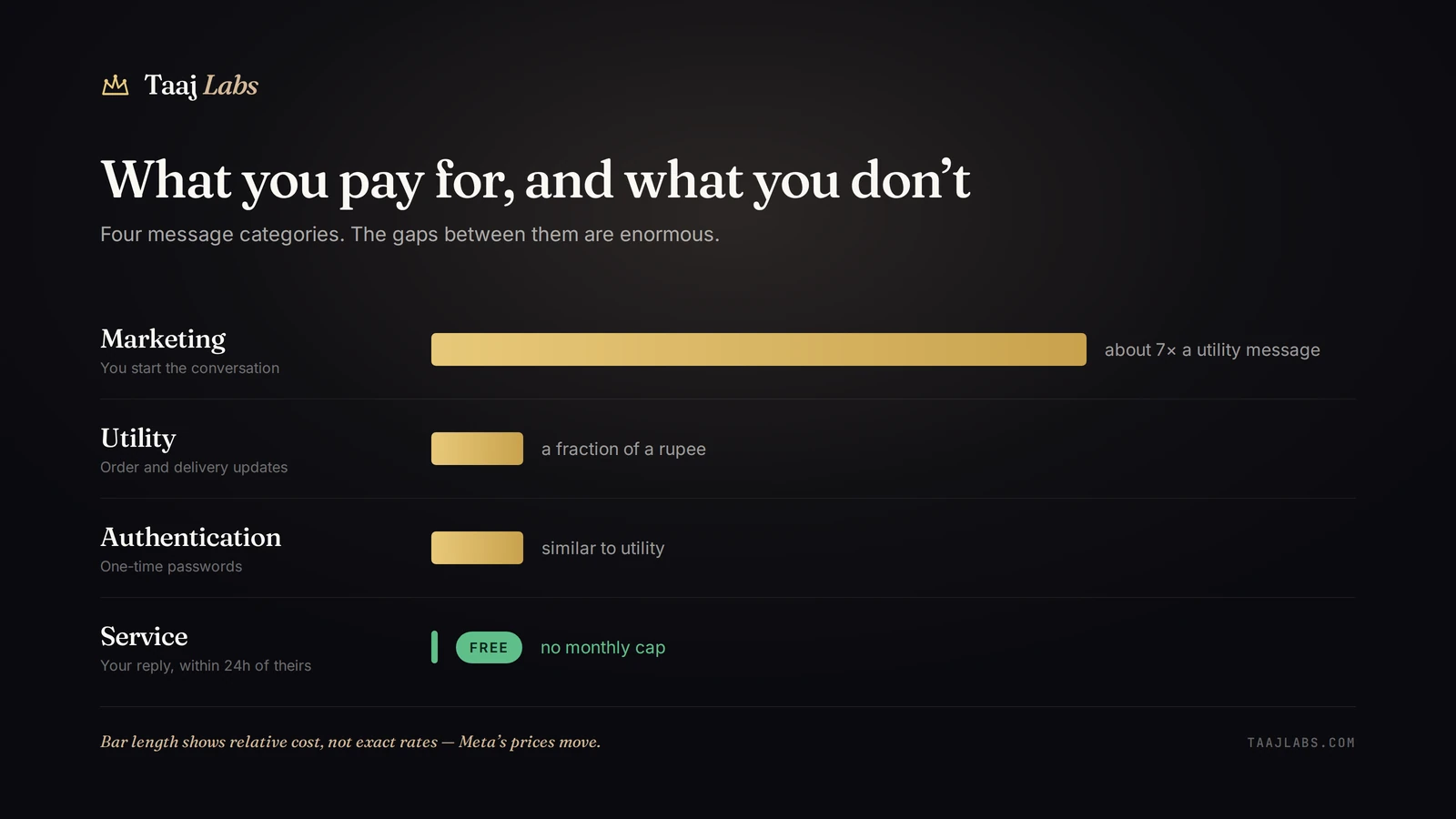
That last line is the one that matters, and it has been true since November 2024. A service message is any reply you send within twenty-four hours of a customer messaging you first. There is no charge and no ceiling.
Read that again in terms of your actual business. A customer messages you asking about a product. For the next twenty-four hours, every reply you send — answering questions, sending the catalogue, confirming the order, sharing a payment link, arranging delivery — costs nothing.
The entire inbound sales conversation is free. You pay to interrupt people. You do not pay to serve them.
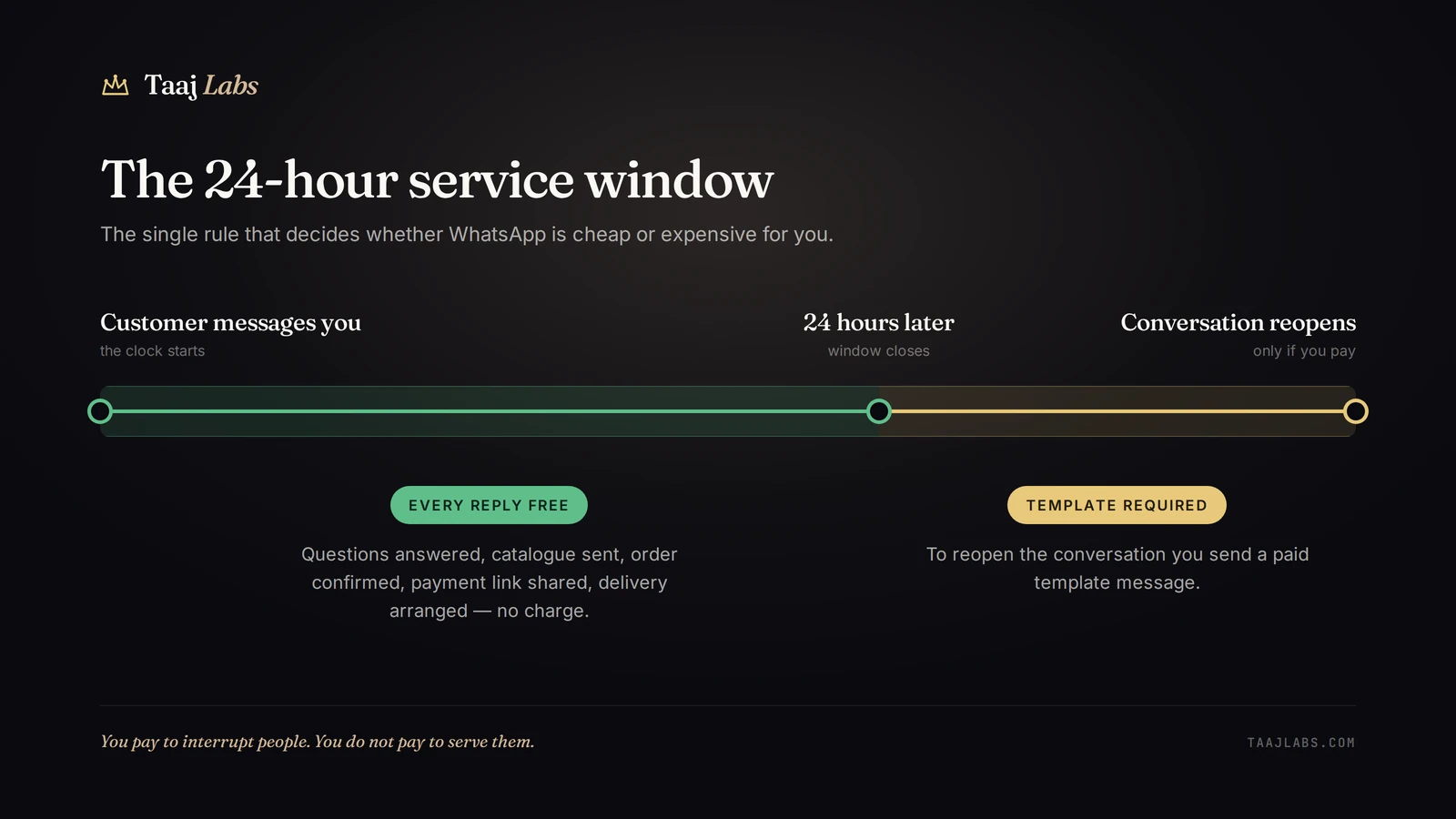
Which reframes the whole exercise. If your plan is broadcasting offers to a bought list, you're on the expensive side of the table and the maths gets ugly quickly. If your plan is answering the customers already messaging you, faster and at any hour, you're on the free side, and the only real cost is the automation itself.
We've deliberately not printed a rate card here. Meta's rates move — the marketing rate rose about ten percent at the start of 2026 — and they vary by country, so any number we published would be wrong by the time you read it. When you ask a provider for pricing, ask for the all-in figure: Meta's rate is only the floor, with 18% GST on top, plus whatever the provider charges as a platform fee or per-message markup. The difference between the headline rate and what actually leaves your account is not small.
Payments: the trap
WhatsApp Pay is live in India. The NPCI removed its hundred-million-user cap in September 2025, so every Indian WhatsApp user can now use it.
Do not build your checkout around it.
WhatsApp Pay holds well under one percent of India's UPI volume. Your customers are on PhonePe and Google Pay, and a checkout that only offers WhatsApp Pay will ask most of them to change habit at the exact moment they were ready to pay. That is the worst possible moment to introduce friction.
What works instead is WhatsApp Flows with a payment gateway — Razorpay or PayU — behind it. The customer pays with any UPI app, any card, or net banking, without leaving the conversation. You get every payment method your customers already use, and you keep the in-chat experience that made this worth doing.
The native-payments pitch sounds cleaner. The gateway route converts better.
Who should not do this
We would rather talk you out of it now than take the money and watch it sit unused.
Skip it if your volume is low. If you're handling fifteen or twenty customer conversations a day, you can answer them yourself, and you'll answer them better than any automation. The tooling earns its place when the queue is long enough that people wait — or long enough that you stop sleeping properly.
Skip it if your catalogue changes hourly. Hourly sync plus fast-moving prices equals wrong prices in front of customers, and that costs more in trust than the system saves in time.
Skip it if what you actually need is a website. Some businesses reach for WhatsApp commerce because a proper store feels like a bigger project. If customers need to browse, compare and search, they need a store. The catalogue is a shortlist, not a shop.
Skip it if nobody will maintain it. A catalogue with last season's stock and old prices is worse than no catalogue.
What we'd actually build
For most businesses that come to us, the answer isn't the full commerce stack. It's narrower, and it lands sooner.
Start on the free side of the pricing table. An agent that handles inbound conversations — answers product questions in Punjabi, Hindi or English depending on how the customer writes, sends the right catalogue items, and hands over to a human the moment it hits something it shouldn't guess at. Service messages, so no per-message cost, and it works at eleven at night when you've closed.
Add utility messages where they pay for themselves. Order confirmations and delivery updates cost a fraction of a rupee each outside the service window — less than the phone calls they replace.
Leave marketing messages until the rest is working. They cost several times what utility messages do, and they are how businesses get themselves blocked.
Then add the catalogue and multi-product messages once you know which thirty products actually move in chat. That's a decision better made from your own conversation data than from a spreadsheet on day one.
Building something like this, or trying to work out whether it's worth it for your shop? We'd rather give you a straight answer than a proposal. contact@taajlabs.com, or WhatsApp us on +91 70301 22334 — which, obviously, is a service message, so it costs us nothing to talk to you.
Curious what this could do for your business?
We will tell you honestly what's ready for it and what isn't — no hype, no lock-in.
Talk to us